
What Does Science Sound Like?
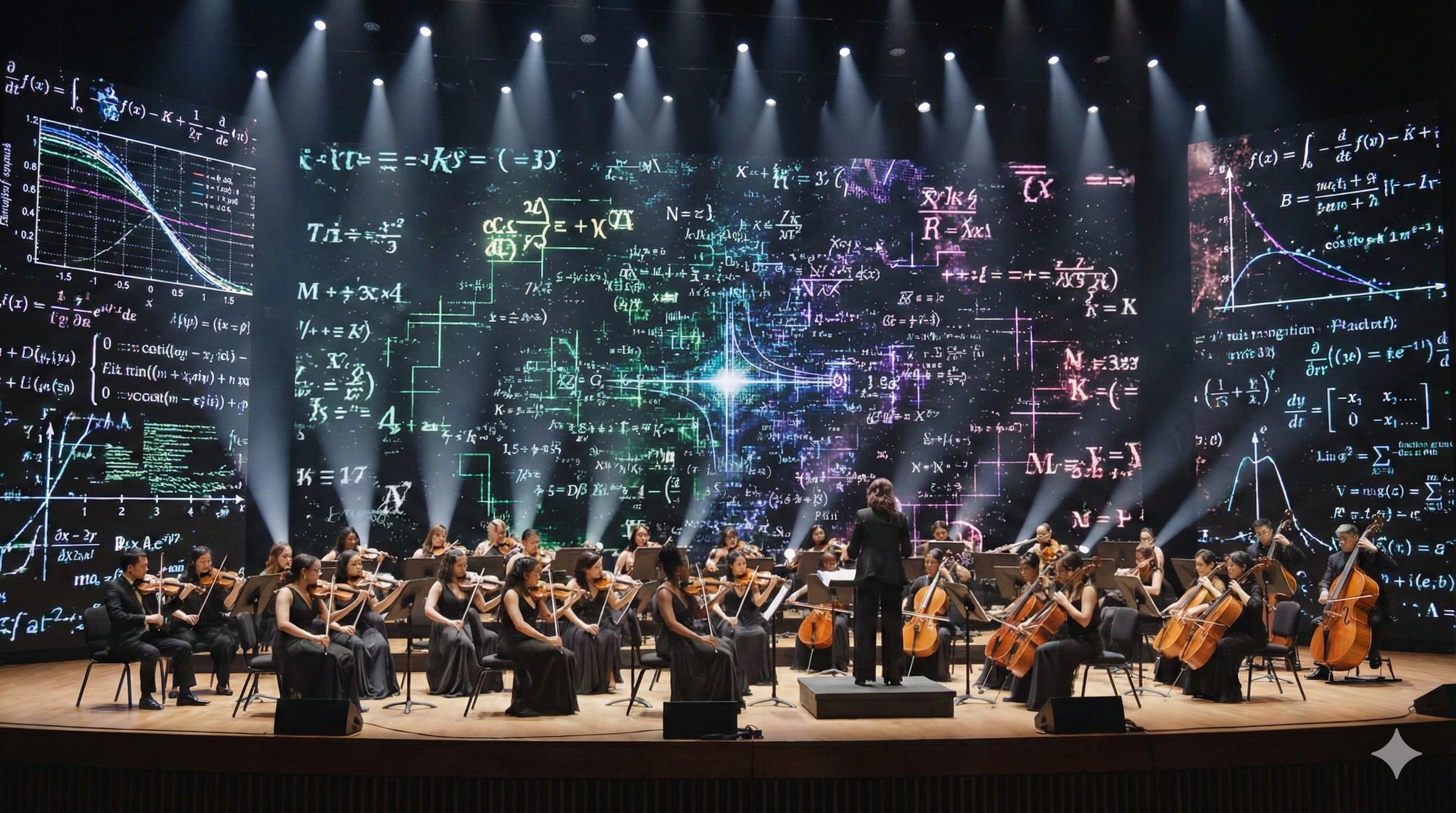
Scientists spend years learning to listen - to lectures, to conference presentations, to the endless hum of lab equipment. But what if we listened to the data itself? Not metaphorically, as in “let the data speak,” but literally converting measurements into sound waves and transforming datasets into audible patterns. This is sonification, and it turns genome sequences into melodies, seismic waves into rumbles, and light curves into symphonies. Sometimes the ear catches what the eye cannot, revealing patterns that remain hidden in traditional visualizations. While our eyes might miss a tiny ‘glitch’ in a scatter plot, our ears are incredibly sensitive to a note that’s slightly out of tune or a rhythm that skips a beat.
Soni-What?!?
Sonification. It’s the process of turning nonauditory data into sound. Variations of this process date back to at least the 1750s where it was a popular element of games in Western Europe. The Musikalisches Würfelspiel (German for “musical dice game”) used dice to randomly generate music from precomposed options. Perhaps the precursor of AI generated music topping today’s charts?
There is a serious side to sonification and experimental results have shown its scientific utility. People with no formal training in music are able to make useful distinctions in scientific data and the technique has been used as an assistive tool for the visually impaired. Sonification is being used across fields like astronomy (hearing galaxy structures), biology (listening to DNA), physics (gravitational waves), and environmental science, providing another sensory layer to analysis beyond traditional graphs and images.
We’re not looking to do any specific analysis. We just want to have some fun with data and introduce you to the notion of open science along the way. Because for sonification to work, the data must be accessible in the first place.
Open Science
For centuries, scientific research has operated a bit like an exclusive club: findings got published in expensive journals most people couldn’t access, data stayed locked on researchers’ computers, and you basically had to be part of the academic in-crowd to see how the scientific sausage was made.
Open science flips that model on its head by making research papers, data, methods, and even the messy trial-and-error process freely available to anyone with an internet connection. Open science is like a potluck dinner where everyone brings their best dish and the recipe.
Think of it as science deciding to show its work. This transparency doesn’t just make science more democratic; it actually makes it better, because more eyes catching errors, more minds building on discoveries, and more diverse perspectives challenging assumptions means we get closer to the truth faster. Plus, if your tax dollars are funding research into, say, whether cats can taste sweetness (they can’t, sadly), shouldn’t you be able to read about it without paying $40 for the privilege?
The open science initiative we want to focus on is EarthArXiv a free online repository where researchers can share their findings before going through the slow-paced peer review process. EarthArXiv lets scientists post “preprints” – completed research that has not been peer reviewed - so the world doesn’t have to wait. It’s run by volunteers, for the community, with no profits and no paywalls, meaning whether you’re a tenured professor or a curious high schooler in Kansas, you can access cutting-edge Earth science research and share your own work.
Sonification of Earth science publications
Not only can you freely publish and share science, but you can also freely and openly query the EarthArXiv system via community developed tools. I wrote software to query EarthArXiv, look at publication dates, and calculate how many submissions occurred each week. From there, I used more open tools to sonify the data.
There are two components to sonification. The first is algorithmic in that we need to map our data to the range of musical notes. The second component is more artistic where we can experiment with scales and note duration to make the sonified data sound a little more pleasing.
The first step in the process is to convert each data point into a pitch (musical note). This means mapping the volume of submissions per week to the frequency of the notes. MusicAlgorithms is one method of accomplishing this. It’s a free online tool for exploring music composition and analysis. The “mapping” is a mathematical translation: a low number of preprint submissions should sound like a deep, low note, while a busy week of research should be more high-pitched. The range of our data is not very large so I chose to constrain our music around middle C on a piano (the key that’s roughly in the middle of a piano keyboard). The mapping process also provides options for the duration of each note; e.g. whole note, half note, quarter note, etc. Finally, we’re asked to choose a musical scale for our sonified data. Scales are often associated with emotion and musicians use different scales to convey feelings in their pieces. This is the point where I admit I’m a musical theory novice and just went with one of the most popular scales. I chose the C-major scale; its happy, upbeat tone felt representative of the science community I know.
The output of MusicAlgorithms is a MIDI file, which is a technical standard for digitally encoding music and working with audio devices. This MIDI file is included in the above link and can also be imported into common music software, such as GarageBand, where we can assign various instruments to play the encoded music.
So, what does Earth science actually sound like?
Here’s a classical music representation of the submission data played by a string ensemble.
Not a fan of classical music? Try this rock version. Here an electric guitar plays the submission data while drums accompany in the background.
Ever wonder what open science sounds like on a cathedral organ? Probably not. Here you go anyway.
While the string ensembles and electric guitars offer a great window into the data, they represent a snapshot from a few years ago. This is where the true beauty of open science comes into play. Because the original EarthArXiv data was - and remains - publicly and freely available, I was recently able to revisit this project and update the “sound” of science. Here’s a new AI collaboration with Claude
This isn’t just a fun tech update; it’s a practical example of why open data matters. When we share our work openly, it doesn’t just sit on a digital shelf—it evolves, improves, and finds new ways to be heard.
Now that you’ve heard what Earth science sounds like, what other scientific mystery deserves a soundtrack? Would you want to ‘hear’ the migration patterns of birds, or perhaps the ‘music’ of a solar flare? Leave your suggestions in the comments. And, to all those who are part of open science - Thank You! Your efforts are reflected in the music. Rock on!
Additional Resources
Want more sonification? Aside from the MusicAlgorithms website, there are many sonification tools available for popular programming languages. There’s audiolyzR for R and miditime for Python to name a few. I’ve also heard good things about Sonic Pi although I’ve not had a chance to try it myself.
There’s also Climate Data Turned into Music, our galaxy’s rotation turned into blues music, and this wonderful sonification of a university’s library checkouts